
Before You Hire an AI Agent, Fix These Five Marketing Problems
Give automation a clear job, reliable information, and a process worth repeating.
A potential customer asks whether you can help with their website.
Your AI agent responds immediately. It sends a polished introduction, describes your services, and offers a booking link.
There is just one problem: the customer needs an online store, your introductory package excludes ecommerce, and the booking link leads to a calendar nobody monitors.
The response was fast. The experience was poor.
This is the danger of adding AI to marketing before fixing the process underneath it. Automation can make a good system more reliable. It can also repeat a confusing message, route people to the wrong offer, and create more work for your team.
An AI agent, in this context, is software that uses an AI model and connected tools to carry out tasks within defined permissions. Depending on its setup, it might classify inquiries, draft content, update customer records, or coordinate follow-up.
That can be useful. But connecting an agent to your inbox does not give your business a clear offer, a working sales process, or accurate information.
Before you hire—or build—one, address these five problems.
1. Your Offer Is Too Vague
Ask three people on your team what your business sells.
If you get three different answers, your AI agent will inherit the confusion.
Many businesses describe themselves using broad phrases:
- “We help brands grow.”
- “We provide innovative digital solutions.”
- “We transform your online presence.”
- “We use AI to take your business to the next level.”
These statements leave the customer with the important questions.
What do you actually do? Who is it for? What will I receive? What happens next?
An agent given vague information may produce fluent copy that still fails to answer those questions. Worse, it may fill in missing details with promises you never intended to make.
Fix it: Write a one-page offer brief
Document:
- The customer: Who is this offer designed for?
- The problem: What specific situation does it address?
- The deliverable: What does the customer receive?
- The boundaries: What is included and excluded?
- The price: What can be quoted, and what requires a conversation?
- The next step: What should an interested person do?
For example, replace:
We offer AI-powered marketing solutions.
With:
We help independent service businesses organize website inquiries and follow-up. The setup includes a contact form, a shared lead tracker, approved acknowledgment messages, and staff notifications. Custom integrations are quoted separately.
The second description gives both the customer and the agent something concrete to work with.
For a digital product, the same principle applies. “A complete marketing system” is less informative than a clear description of the guide, worksheets, prompts, and campaign examples included.
Readiness test: Can someone unfamiliar with your business explain the offer accurately after reading your brief?
Then give AI this job: Draft or adapt messages using the approved offer, flagging questions the brief does not answer.
2. Your Customer Journey Has Missing Steps
Someone clicks an ad, downloads a resource, submits a form, or books a call.
Then what?
For many small businesses, the answer depends on who happens to notice.
A contact form sends an email to an old address. A sales conversation ends without an agreed next step. A customer replies to an automated message, but the sequence keeps running as though nothing happened.
These are process problems.
An agent cannot reliably coordinate a customer journey that nobody has defined. It needs to know what happened, what should happen next, and when to stop.
Fix it: Map one journey from start to finish
Choose a common entry point, such as a website inquiry.
Write down the sequence:
- The visitor submits the form.
- The inquiry is recorded.
- The customer receives an acknowledgment.
- A named person reviews the request.
- That person answers the question or proposes a next step.
- Follow-up happens if appropriate.
- The record is updated when the inquiry closes.
Now add the exceptions.
What happens if the person is already a customer? What if the request is urgent? What if they reply, decline, or book elsewhere? What happens when a calendar or email connection fails?
A workable process includes those situations.
Separate acknowledgment from response
“We received your message” is useful, but it is not the same as helping someone.
Track the time until a meaningful response: an answer, a relevant question, or a clear next step.
Otherwise, an automation dashboard may report instant service while customers are still waiting.
Readiness test: Can you trace a recent inquiry from arrival to its current status without searching through several inboxes?
Then give AI this job: Summarize inquiries, suggest routing, create tasks, and draft responses for the appropriate person.
3. Your Business Information Is Scattered or Outdated
Your website lists one price. Your proposal template lists another. A salesperson uses a third.
Your FAQ says setup takes two weeks. Your current workload means it may take longer.
Your AI agent has access to all of it.
More information does not necessarily create a more reliable assistant. Conflicting information gives it more ways to produce an answer that sounds reasonable but is wrong.
The same issue appears in content production. An agent may reuse an expired offer, describe a discontinued service, or present an old example as current.
Fix it: Create a small, maintained reference set
Start with the information customers need most often:
- Current offers and prices.
- Included and excluded services.
- Common questions and approved answers.
- Booking and contact links.
- Relevant policies.
- Verified examples and claims.
- Brand voice and writing examples.
- Topics that require a human response.
Give each document an owner and a review date.
Label archived material clearly, or remove it from the agent’s active reference set. Define which document takes precedence if information conflicts.
Keep sensitive customer information separate from general marketing knowledge. An agent drafting public content should not have broad access to private records simply because connecting everything is convenient.
Tell the agent what to do when information is missing
A useful instruction is:
Use the approved reference material for factual claims. If the answer is missing, conflicting, or out of date, flag it for review rather than filling in the gap.
That instruction still needs testing and oversight. It is a starting rule, not a guarantee.
Test questions such as:
- “Can you guarantee this result?”
- “Can I get a discount?”
- “Can you deliver by Friday?”
- “Does this package include a feature that is not listed?”
Readiness test: Can your team identify the current, authoritative answer to those questions?
Then give AI this job: Retrieve approved information, draft consistent answers, and identify gaps that need updating.
4. Your Content Attracts Attention Without Creating a Next Step
An AI agent can help you produce more posts. That does not solve the problem of posts that lead nowhere.
A business can publish useful tips every day while giving its audience no clear reason to visit the website, subscribe, request help, or buy.
Sometimes the disconnect is obvious: a post about one problem links to an unrelated offer.
Sometimes it is subtler. The content is so broad that it attracts people who enjoy the advice but have little need for the business behind it.
Fix it: Connect the topic, resource, and offer
For each content idea, answer:
- Who is this for?
- What problem does it help them understand or solve?
- What would be a useful next step?
- How does that step relate to what we sell?
For Gorilla Marketing Pro, a connected sequence could look like this:
ContentUseful next stepRelevant offerAn article about inconsistent campaign planningComplete a campaign-planning worksheetPlaybook + Editable Field KitA video about missed website inquiriesReview a follow-up checklistAn inquiry automation serviceA post about generic AI writingTry a brand-voice exerciseA prompt and workflow resource
Not every post needs to sell something. Some content earns familiarity, answers questions, or supports existing customers.
But the overall system should help an interested person move forward.
Improve the destination before increasing traffic
Follow your own links.
Does the landing page explain the offer? Is the form usable on a phone? Does the download arrive? Does the booking link work? Is the purchase process clear?
Sending more people into a confusing experience can increase the amount of opportunity you lose.
Readiness test: Can you explain the purpose of your next five pieces of content—and where an interested reader can go next?
Then give AI this job: Turn an approved article, demonstration, or interview into distinct supporting pieces with appropriate calls to action.
5. You Have No Clear Definition of Success—or Limits on What the Agent Can Do
“Save time and grow the business” is a reasonable ambition. It is not a sufficiently precise assignment.
Without a baseline, you cannot tell whether the agent helps. Without clear permissions, you may discover what it can do only after it does something you did not expect.
An agent might create hundreds of drafts while consuming hours of review time. It might send duplicate follow-ups. It might offer a discount because that seems like a helpful way to complete its task.
You need both a scorecard and operating boundaries.
Fix it: Write a short operating brief
Define the task, the outcome, the permissions, and the owner.
| Question | Example answer |
|---|---|
| What is the task? | Prepare new inquiries for staff follow-up |
| What should improve? | Fewer missed inquiries and less sorting time |
| What can it do automatically? | Summarize, categorize, and create a task |
| What requires approval? | Customer-specific replies, prices, and commitments |
| When should it stop? | Missing information, conflicting records, or a customer asking for a person |
| Who owns the workflow? | A named team member |
| How can it be paused? | A documented switch or procedure |
Begin with the smallest set of permissions needed for the job.
Drafting a message and sending it are different responsibilities. Reading a customer record and modifying it are different responsibilities. Keep those distinctions explicit.
Measure the full workload
Suppose a task previously required five hours a week.
With AI, initial processing takes one hour, but checking and correcting the output takes three hours.
You saved one hour—not four.
Include review, maintenance, exceptions, and tool costs when evaluating the result.
Useful measures include:
- Time to meaningful response.
- Percentage of inquiries handled.
- Accuracy of classifications and summaries.
- Number of corrections required.
- Qualified next steps completed.
- Total staff time.
- Duplicate messages or other failures.
Readiness test: Could you tell, after a limited pilot, whether the agent improved the process?
Then give AI this job: Perform the defined task within its permissions, while recording enough information for someone to review what happened.
Start With One Boring, Valuable Job
The most useful first agent may never appear in a promotional video.
It might organize inquiries, prepare meeting notes, flag unanswered questions, or turn approved material into a draft newsletter.
Choose a task that is frequent, clearly defined, easy to review, and reversible if something goes wrong.
A sensible first pilot is inquiry triage:
- A form submission arrives.
- The agent summarizes the request.
- It suggests a service category.
- It flags missing information.
- It creates a follow-up task.
- A person reviews the result and contacts the customer.
That is enough to learn whether the system saves time and handles real-world variation.
Test routine cases and awkward ones: duplicate submissions, vague requests, existing customers, conflicting details, and messages containing instructions that should not override your business rules.
Expand its responsibilities only when the evidence supports doing so.
Your Pre-Agent Checklist
Before you connect an AI agent to your marketing, make sure you can answer yes to these questions:
- Is our offer specific and documented?
- Does every inquiry have a clear next step and an owner?
- Is our reference information accurate and maintained?
- Does our content connect to a relevant customer journey?
- Have we defined success, permissions, exceptions, and a way to pause the system?
If a few answers are no, you have found useful work to do before adding another subscription.
You may also find that part of the job needs ordinary automation rather than AI. Sending an approved receipt, assigning a task based on a form selection, or stopping a sequence after a booking can often follow straightforward rules. Use AI where interpreting language or preparing a draft adds value.
Give the Agent a Business Worth Representing
An AI agent will not decide what your business should promise, what your customers need most, or which relationships deserve personal attention.
Those decisions belong to you.
Make the offer clear. Repair the handoffs. Maintain the information. Connect the content. Set the boundaries.
Then give the agent a specific job and measure whether it performs that job well.
Before you automate more marketing, make your marketing easier to understand, easier to manage, and easier for a customer to act on.
Take one marketing idea from your notes to launch.
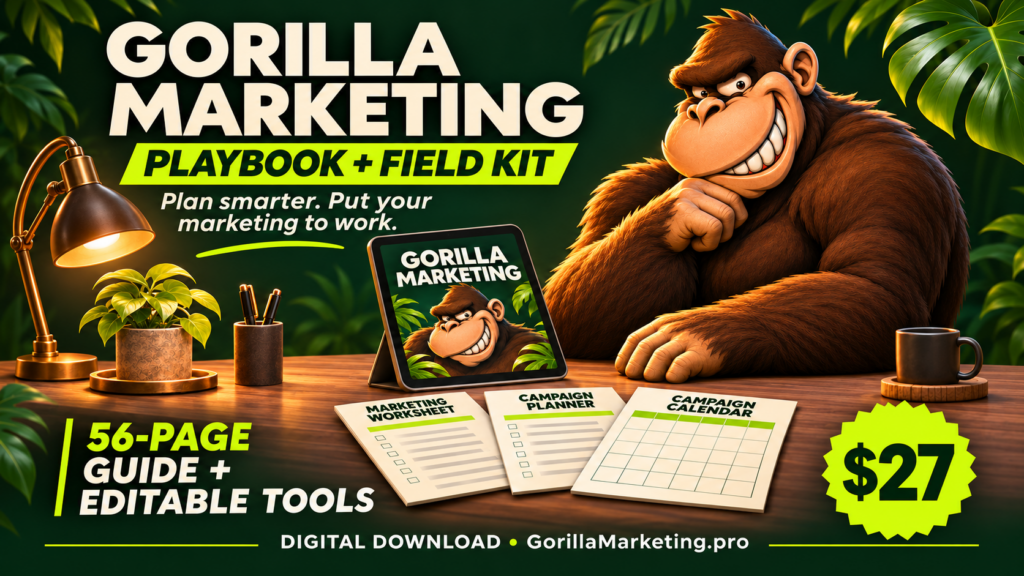
Pick a promotion you’ve been meaning to run. Maybe it’s a new offer, a product launch, or a campaign to bring more people to your site. The Gorilla Marketing Playbook + Editable Field Kit helps you decide what to try first, how much to spend, and what to measure once your campaign is live.
Start with one of three worked campaigns and adapt its budget to your business. Use the editable worksheets to map out the campaign, the scripts and AI prompts to draft your materials, and the 30-day action plan to decide what needs to happen each week.
Once you launch, use the campaign tracker to record what you tried and how people responded. You’ll have a record of what to repeat, what to change, and where to spend your time on the next campaign.
Get the Gorilla Marketing Playbook + Editable Field Kit for $27 →
One-time purchase. Includes the 56-page illustrated PDF and editable ZIP toolkit.
Leave a Reply